The Sydney startup will setup a basic quantum computer in an Equinix data centre by October, it said on Tuesday, as it moves to commercialise a technology that’s been in R&D phase for decades.
Key Takeaways
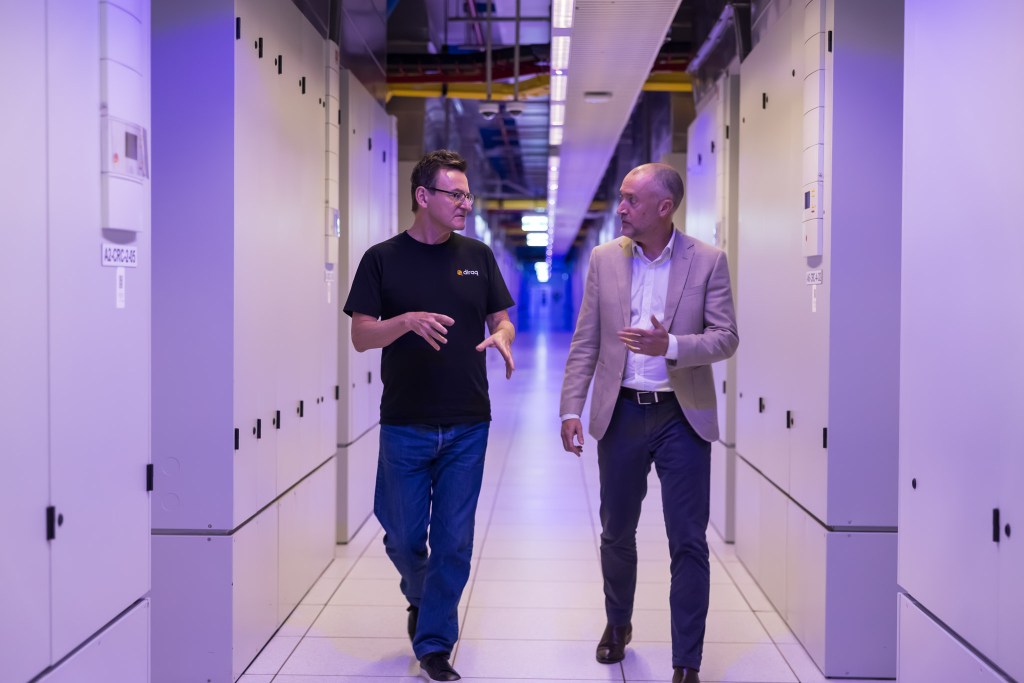
- Diraq, an NRFC-backed Sydney quantum computing startup, will install a prototype quantum computer within an Equinix data centre by October.
- Though the quantum unit will not come close to the horsepower needed for commercial tasks, it will seek to prove the nascent technology can function within existing data centre infrastructure.
- Diraq will test how its quantum computer operates in a live commercial data centre and experiment with fusing quantum and AI technologies.
- The startup’s quantum chips are designed to be manufactured in the same foundries that produce the processors that power phones and laptops, unlike competitors which require specialised manufacturing methods.
- Diraq has said it’s aiming to have a fully realised quantum computer up and running by 2031, with an earlier version ready to market by 2029.
- It signed a letter of intent with the US Department of Commerce worth up to US$38 million, and is part of a Defence program that could see it net hundreds of millions in funding.
Key Background
Proponents of quantum computing say it could be a US$200 billion industry that will enable fundamental breakthroughs in engineering, finance, chemistry and agriculture. But for this potential to become a reality, someone first needs to develop a quantum computer containing millions of quantum bits, or qubits, and make that compute accessible via the cloud.
The quantum computing unit Diraq says it will install in an Equinix data centre by October will be just eight qubits, a small fraction of what’s required to fulfil the technology’s potential. But it is a step that will get it closer to taking qubits out of the lab and into the market.
Equinix is one of the bigget data centre companies in the world, with a market cap of US$103 billion.
Quantum companies in Australia and around the world are rushing to commercialise the technology, seeking to prove it’s far more than fodder for academia. Silicon Quantum Computing, a startup founded by Michelle Simmons, has been trialling its own quantum wares with investors Telstra and Commonwealth Bank among others.
Diraq says it will have its flagship product, what the industry calls a “fault-tolerant” quantum computer, by 2031.
It is not the first Australian quantum computer to go into such a facility. In 2022 Quantum Brilliance integrated one of its units into the Pawsey Supercomputing Research Centre. But Diraq says its unit will work in a live commercial data centre, similar to but distinct from a research centre.
The US Government has taken an interest in both Diraq and SQC. Both are in Stage B of the Department of Defense’s Quantum Benchmark Initiative, which seeks to identify quantum outfits that can build a fault-tolerant machine by 2033. If they graduate the Stage C, they will receive up to US$300 million ($418 million) in supporting funds.
Diraq also signed a letter of intent with the Department of Commerce that could see it score a contract worth up to US$38 million ($53 million) to establish a supply chain in the US.
Crucial Quote
“The data centre is where quantum computing goes mainstream, and that shift starts now,” said Andrew Dzurak, Diraq Founder and CEO.
“We believe the future of computing will be quantum-enhanced and AI-enabled… Rather than replacing today’s systems, quantum computers will work alongside AI and classical infrastructure to solve problems that are currently out of reach. By bringing quantum into a commercial data centre, we’re helping pave the way for that future.”
Want to see more Forbes articles on your feed? Tap here to make Forbes Australia a preferred source on Google.
Look back on the week that was with hand-picked articles from Australia and around the world. Sign up to the Forbes Australia newsletter here or become a member here.