

After a career at the forefront of physics, Daniel Shaddock turned years of research into Liquid Instruments. More than a decade on, the company has just secured $70 million to accelerate its next phase.

Few would have expected Daniel Shaddock to pursue a career in physics. As a child, the Canberra-based CEO was, by his own admission, “probably more into football than science.”
What he did have, however, was a competitive streak and an appetite for solving difficult problems. Physics, he says, became less about a fascination with science than a way to challenge himself.
“I like solving hard problems – and there are a lot of hard problems out there. The trick is to choose the hard problems that are interesting to work on and are also meaningful to you,” he says.
To Shaddock, few problems were more meaningful than gravitational wave detection.
“Everything we know about the universe basically comes from the equivalent of looking at it,” he says. “Gravitational waves opened an entirely new way of experiencing it. In some ways, it gave humanity a new sense.”
His work later took him to NASA’s Jet Propulsion Laboratory, where he helped adapt the technology for use in space. In an effort to simplify one of the world’s most complex measurement systems, Shaddock began working with reconfigurable hardware that could perform multiple functions via software.
After returning to Australia as a professor at the Australian National University, Shaddock and several colleagues began to realise the technology had applications far beyond research laboratories.
“It became clear to us that this technology was actually super useful and that we could do something a little bit closer to Earth that would benefit a lot of people,” he says. “That’s when we decided to start Liquid Instruments.”
Founded in 2014, the company develops software-defined test equipment that replaces multiple laboratory instruments with a single reconfigurable platform.
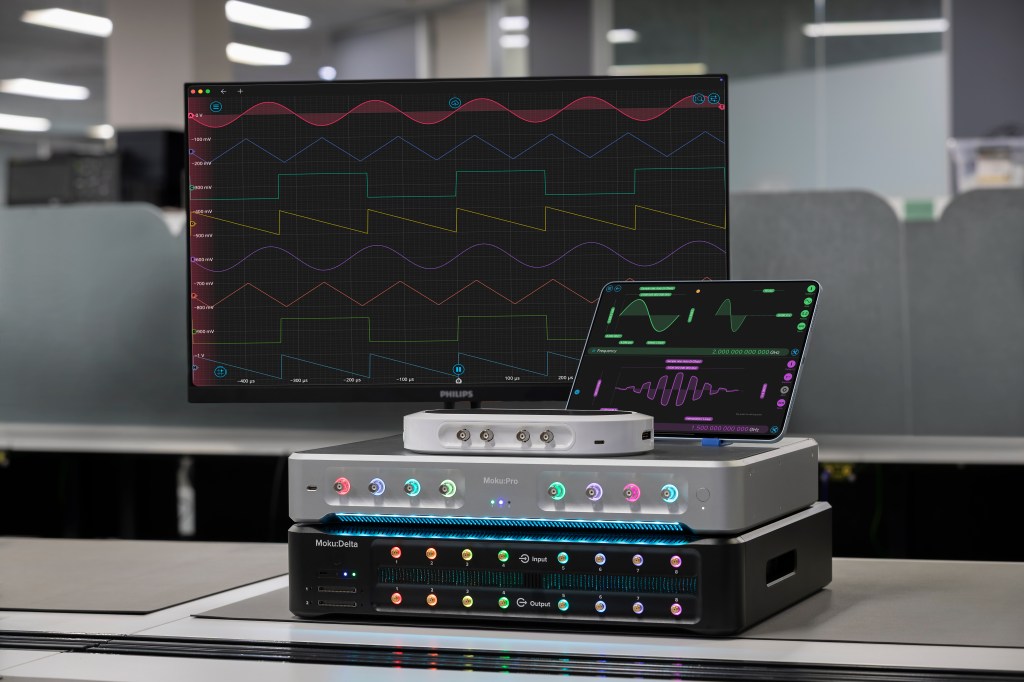
“Because it’s software-defined, it can be very flexible,” Shaddock says. “When we started the company, our first device replaced three different instruments. Today, the same hardware can replace 17 because we’ve continued to release new designs through software updates.”
The versatility of the platform has seen its adoption across industries ranging from semiconductors and quantum computing to aerospace, defence and electric vehicles, with customers including NVIDIA, Apple, Blue Origin, Lockheed Martin and BYD.
“We’re now a team of around 100 people, generating tens of millions of dollars in annual revenue and selling to many of the world’s leading technology companies,” Shaddock says. “It’s pretty gratifying to see how far we’ve come.”
Go Big or Go Home
Developing the technology was one thing, but building the company around it proved to be another.
When the idea for Liquid Instruments emerged, Shaddock was a full professor at ANU with a secure academic career ahead of him.
“I had a cushy job for the rest of my life if I wanted just to run down the clock,” he says. “But that didn’t particularly appeal to me.”
Despite the technology’s potential, Shaddock was hesitant to leap into business. Throughout his academic career, he had largely dismissed the idea of commercialising research, viewing most opportunities as too niche to make a meaningful impact.
“Making the jump definitely wasn’t natural,” he says. “It was actually something I was really scared of.”
This opportunity, however, felt different.
“I really felt like it could help hundreds of thousands of scientists and engineers,” he says. “The world needs scientists and engineers, and if we’re going to solve the world’s biggest problems, technology has a really big part to play.”
“I was so scared that I thought, ‘Maybe this is actually important.’ The trick was convincing myself that the fear was excitement, and that it was worth taking a chance on something I believed was important.”
Once he had made that decision, there was no intention of thinking small.
“I didn’t want to run this as a small business. It was a ‘go big or go home’ attitude,” he adds.
From the outset, that meant looking internationally. Rather than focusing on Australia first, Liquid Instruments established an early presence in the United States.
“We were part of an international community, and we definitely brought that mindset to everything we did in the company,” he says. “Technology is a very globally competitive landscape. People want the best technology, no matter where it comes from. You’re not just trying to be the best in Australia; you need to be the best, period.”
More than a decade on, that global-first approach has helped turn Liquid Instruments into one of Australia’s more prominent deep-tech companies.
Earlier this year, Liquid Instruments raised a $70 million Series C round, valuing the company at more than $400 million. For Shaddock, however, the milestone is less about the valuation than what it enables.
“We’ve always had more ideas than we’ve had resources to execute on,” he says.
The company is now investing heavily in artificial intelligence, aiming to enable engineers to create entirely new test instruments simply by describing what they want to measure.
“Because our instruments are software-defined, they have all the hooks needed for AI to really take control and transform them at a very fundamental level,” Shaddock says.
“If we can improve the efficiency of that engineer by allowing them to create instruments on demand, it’s going to be a real game changer.”
For Shaddock, the latest advances in AI are simply the next chapter in a career built around solving hard problems – this time by giving others the tools to solve their own.
“I really do like building instruments,” he says. “It’s not just useful for my own project – I can share it with a lot of other people and help them do their work better as well. I find that quite satisfying.”
Want to see more Forbes articles on your feed? Tap here to make Forbes Australia a preferred source on Google.
Look back on the week that was with hand-picked articles from Australia and around the world. Sign up to the Forbes Australia newsletter here or become a member here.