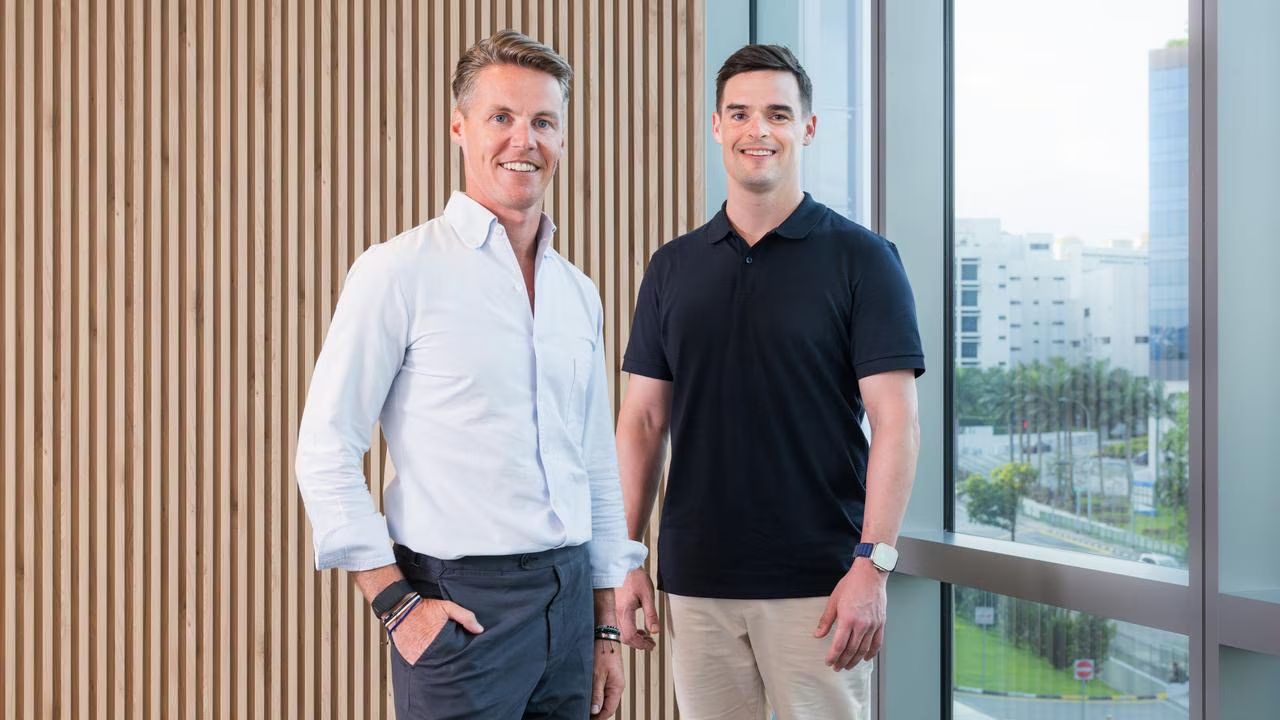
Alex Zaccaria, the co-founder of unicorn Linktree, is among the Australian founders aggrieved by proposed changes to the capital gains rate. He believes the Government is well intentioned, but that the result will see more and more Australian startups shifting their centre of gravity to the US.

Alex Zaccaria already spends half the year in San Francisco as part of his efforts to grow Linktree into a global social media champion. With the Albanese Government’s proposed changes to capital gains tax, he’s now thinking about making a permanent move.
“I’ve already instructed my accountant to look at this,” Zaccaria told Forbes Australia, referencing a US relocation. “I would have to wait for the advice on what makes sense for the company. Personally, I would consider becoming a tax resident in the US.”
Zaccaria is among those in the startup and venture capital sector alarmed by the new capital gains regime proposed by the 2026/27 Budget. The change would see the existing 50 per cent capital gains tax discount scrapped in favour of an inflation-indexed model. For founders and employees selling equity they’ve owned for more than a year, the effective tax rate would rise from 23.5 per cent to a new 30 per cent minimum and up to a possible 47 per cent.
Zaccaria concedes existing founders like himself will do “okay-ish” under the new rules thanks to a clause that protects his existing capital gains tax discount up until Linktree’s valuation as of June 30, 2027. But he says the unintended consequence of the policy will be for talent and investment to slowly drift overseas.
“Equity is also how Australian startups compete for world-class talent against much larger US companies paying materially higher cash compensation,” he said. “If you remove that incentive, capital and talent will naturally move elsewhere over time. It’s not out of ideology or spite, it’s simply how globally mobile companies operate.”
Related

Treasurer Jim Chalmers has said he is open to a carve-out for the startup sector, and is consulting with industry leaders on what that might look like.
Linktree, which began its life as a simple link-in-bio tool but which has grown into e-commerce, last raised capital at a $1.7 billion valuation in 2022 and counts Airtree and Google among its backers. Most of its employees are now in the US – around 139 there versus 84 in Australia, according to LinkedIn data. Zaccaria says the company’s centre of gravity is likely to shift further to the US under these changes.
“We’ll get the valuation as of July 2027, but it doesn’t incentivise us to keep scaling the value of the company post that time in Australia.”
Startups may be hit particularly hard by the capital gains tax changes because they rely on equity offerings as a means of recruiting top talent. Company shares are allocated at a cost base near zero, meaning the tax would impact the entire proceeds of any sale. Most startups fail and need the best talent for any hope of succeeding, Zaccaria said, and the new policy is likely to deprive them of that.
His comments echo sentiments held by much of the sector, but not all of it. Daniel Petre, who co-founded one of Linktree’s earliest backers in Airtree, told Forbes Australia that employees joining multi-billion-dollar startups shouldn’t get any tax concession because they already offer envious employment conditions.
“You’ve joined late into a scaled startup, valued at over a billion dollars, and you expect a break on your shares? Why? You’re not taking risk,” Petre argues. “You’re not being paid under market salary, you’ve got great benefits… what’s the actual rationale argument?”
Others outside the industry have criticised the outcry. Former Prime Minister Paul Keating issued a statement to the Sydney Morning Herald last week criticising the greed of investors calling for concessions, saying they’ve “made a feast of it already.”
“I don’t think this is about greed,” Zaccaria said, adding, “I don’t think anyone is asking for special treatment. Those that start and build businesses including employees pay their fair share in tax. The real question is whether Australia wants to be globally competitive in building high-growth companies.”
Want to see more Forbes articles on your feed? Tap here to make Forbes Australia a preferred source on Google.
Look back on the week that was with hand-picked articles from Australia and around the world. Sign up to the Forbes Australia newsletter here or become a member here.